
Artificial Intelligence in Multidisciplinary Research: Applications, Ethics, Reliability, and Future Directions
Artificial Intelligence in Multidisciplinary Research: Applications, Ethics, Reliability, and Future Directions
Introduction: The Expanding Role of AI in Modern Research
Artificial Intelligence (AI) has rapidly evolved from a specialised field of computer science into a transformative force across nearly every academic discipline. Today, AI is not only shaping technological innovation but also redefining how research is conducted, analysed, and applied.
For multidisciplinary journals like The Spectrum Journal, AI represents a powerful bridge connecting diverse domains such as healthcare, engineering, economics, social sciences, environmental studies, and public policy.
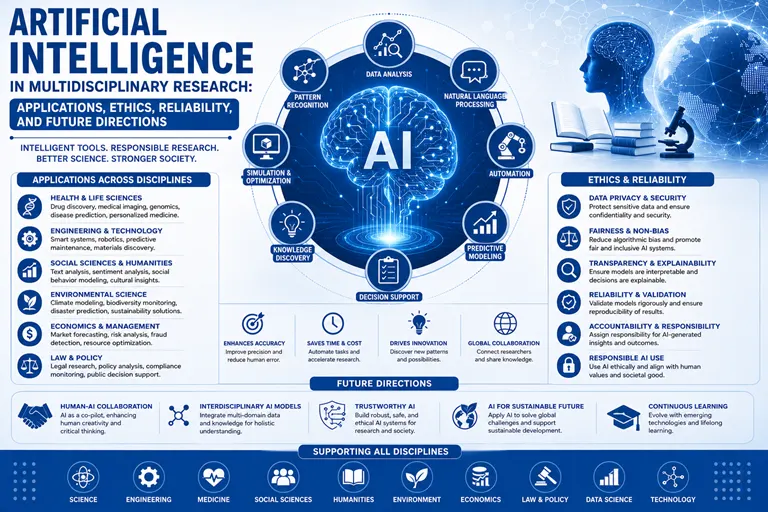
However, alongside its potential, AI also introduces complex questions related to ethics, reliability, and long-term impact.
This article explores how AI is influencing multidisciplinary research, its practical applications, the ethical and reliability concerns it raises, and the future directions researchers must consider.
Understanding Artificial Intelligence in a Multidisciplinary Context
What Makes AI a Multidisciplinary Tool
AI is inherently interdisciplinary because it:
- Combines computer science, mathematics, and statistics
- Integrates domain-specific knowledge
- Supports data-driven decision-making
- Enables automation and predictive modelling
Its adaptability allows it to be applied across fields, making it central to multidisciplinary research.
Core Technologies Behind AI
Key AI technologies include:
- Machine learning
- Deep learning
- Natural language processing
- Computer vision
- Predictive analytics
These technologies are applied differently depending on the research domain.
Applications of AI Across Disciplines
AI in Healthcare and Life Sciences
AI is transforming healthcare through:
- Disease prediction and diagnosis
- Medical imaging analysis
- Drug discovery and development
- Personalised treatment plans
AI in Engineering and Technology
In engineering, AI supports:
- Smart manufacturing systems
- Predictive maintenance
- Robotics and automation
- Infrastructure optimisation
AI in Social Sciences and Economics
AI enables:
- Behavioural analysis
- Economic forecasting
- Policy simulation
- Market trend analysis
AI in Environmental and Sustainability Research
AI contributes to:
- Climate modelling
- Resource management
- Biodiversity monitoring
- Disaster prediction
AI in Education and Humanities
Applications include:
- Adaptive learning systems
- Language processing and translation
- Cultural data analysis
- Digital humanities research
Ethical Considerations in AI-Driven Research
Why AI Ethics Is Critical
As AI becomes more integrated into research, ethical concerns become more prominent.
Key issues include:
- Bias in algorithms
- Data privacy and security
- Lack of transparency
- Accountability for decisions
Bias and Fairness
AI systems can unintentionally reflect biases present in training data, leading to:
- Discriminatory outcomes
- Misinterpretation of results
Researchers must actively address bias during model development.
Data Privacy and Consent
AI often relies on large datasets, raising concerns about:
- Personal data protection
- Informed consent
- Data ownership
Transparency and Explainability
Black-box AI models can make it difficult to understand:
- How decisions are made
- Why certain outcomes occur
Explainable AI is essential for academic credibility.
Reliability and Validity of AI in Research
Ensuring Reliable AI Models
Reliability depends on:
- Quality of training data
- Model validation
- Reproducibility of results
Challenges in AI Reliability
- Overfitting and underfitting
- Data inconsistencies
- Model generalisation issues
Importance of Validation
Researchers must:
- Use robust validation techniques
- Test models across datasets
- Document methodologies clearly
Integrating AI into Multidisciplinary Research Methodology
Combining AI with Traditional Methods
AI should complement, not replace, traditional research methods.
Examples include:
- Using AI for data analysis alongside qualitative insights
- Combining statistical models with machine learning
Collaborative Research Approach
Effective AI integration requires collaboration between:
- Data scientists
- Domain experts
- Policy researchers
- Practitioners
Role of Journals in AI Research Governance
Ensuring Ethical AI Research
Journals like The Spectrum Journal must:
- Enforce ethical guidelines
- Require transparency in AI methods
- Promote responsible research practices
Peer Review of AI-Based Studies
AI-based research requires:
- Reviewers with technical expertise
- Evaluation of methodology and data quality
- Assessment of ethical compliance
Future Directions of AI in Multidisciplinary Research
Emerging Trends
- Explainable AI (XAI)
- AI in policy decision-making
- Human-AI collaboration models
- AI for sustainable development
- Integration with big data and IoT
Expanding Research Opportunities
AI will continue to:
- Enable new research questions
- Improve data analysis capabilities
- Enhance cross-disciplinary collaboration
Challenges and Considerations for the Future
Balancing Innovation and Responsibility
Researchers must balance:
- Technological advancement
- Ethical responsibility
- Social impact
Need for Global Standards
Standardisation in:
- AI ethics
- Data governance
- Reporting guidelines
will be essential for consistency and trust.
Frequently Asked Questions (FAQs)
What is AI in multidisciplinary research?
It refers to the use of artificial intelligence across multiple academic disciplines to solve complex problems.
Why is AI important in research?
AI enhances data analysis, prediction, and decision-making capabilities.
What are the ethical concerns of AI?
Bias, data privacy, transparency, and accountability are key concerns.
How can researchers ensure AI reliability?
Through validation, high-quality data, and transparent methodology.
What is the future of AI in research?
AI will continue to expand across disciplines, enabling innovation and collaboration.
Conclusion: AI as a Catalyst for Integrated Knowledge
Artificial Intelligence is reshaping the landscape of multidisciplinary research. Its ability to integrate data, automate processes, and generate insights makes it a powerful tool for addressing complex global challenges.
However, its success depends on:
- Ethical responsibility
- Methodological rigor
- Transparent reporting
For journals like The Spectrum Journal, supporting AI-driven research means fostering innovation while maintaining academic integrity.
As AI continues to evolve, researchers, institutions, and journals must work together to ensure that its application remains reliable, ethical, and impactful.