Why Multidisciplinary Journals Need a Modern Manuscript Submission and Peer-Review System in 2026
Why Multidisciplinary Journals Need a Modern Manuscript Submission and Peer-Review System
Introduction: The Backbone of a Successful Journal
For any academic journal, the quality of published research depends not only on authors and reviewers but also on the efficiency of the system that manages the entire process.
For multidisciplinary journals like The Spectrum Journal, this challenge becomes even more complex. Submissions arrive from diverse disciplines, each with its own standards, methodologies, and review expectations. Managing this diversity manually or through outdated systems often leads to delays, inconsistencies, and author dissatisfaction.
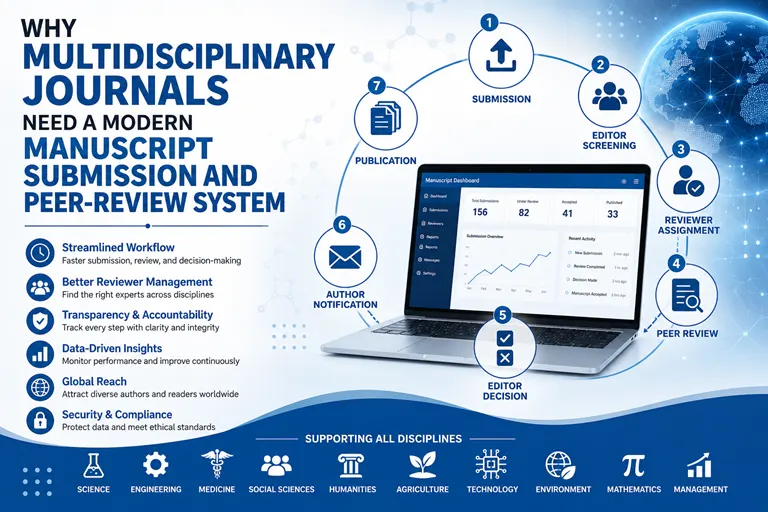
This is why adopting a modern manuscript submission and peer-review system is no longer optional. It is a foundational requirement for credibility, efficiency, and long-term growth.
The Unique Workflow Challenges of Multidisciplinary Journals
Managing Diversity Across Disciplines
A multidisciplinary journal handles submissions in areas such as:
- Engineering and technology
- Health sciences and medicine
- Social sciences and humanities
- Business, management, and economics
- Environmental science and sustainability
Each of these fields requires:
- Different reviewer expertise
- Varying evaluation criteria
- Distinct formatting and citation styles
Without a structured system, this diversity can quickly overwhelm editorial teams.
High Volume and Complexity of Submissions
Multidisciplinary journals often attract a broader pool of authors, which leads to:
- Higher submission volumes
- Increased reviewer requirements
- More complex editorial decisions
A manual or semi-digital workflow cannot efficiently handle this scale.
What Is a Modern Manuscript Submission System?
Beyond Basic Submission Portals
A modern manuscript submission system is not just a form where authors upload files. It is a complete workflow engine that manages:
- Submission intake
- Editorial screening
- Reviewer assignment
- Peer-review tracking
- Decision-making
- Communication
- Final publication
Integration with Publishing Ecosystem
A modern system should seamlessly integrate with:
- Journal website
- Editorial workflows
- DOI registration processes
- Indexing requirements
- Metadata management
This integration is essential for multidisciplinary journals aiming for global visibility.
Limitations of Traditional and Outdated Systems
Manual Tracking and Communication
Many journals still rely on:
- Email-based submissions
- Spreadsheet tracking
- Manual reviewer coordination
This approach leads to:
- Missed communications
- Delayed decisions
- Lack of transparency
Poor Author and Reviewer Experience
Outdated systems often:
- Confuse authors during submission
- Lack clear status updates
- Create friction for reviewers
This negatively impacts submission rates and reviewer engagement.
Lack of Workflow Transparency
Editors may struggle to track:
- Manuscript status
- Reviewer responses
- Decision timelines
This reduces operational efficiency and accountability.
Key Features of a Modern Peer-Review System
Structured Editorial Workflow
A modern system should clearly define each stage:
- Submission received
- Initial screening
- Reviewer assignment
- Review completion
- Editorial decision
- Revision tracking
- Final acceptance
Automated Reviewer Management
Efficient reviewer handling includes:
- Reviewer database management
- Automated invitations
- Deadline reminders
- Performance tracking
This is especially important for multidisciplinary journals requiring diverse reviewer expertise.
Real-Time Tracking and Dashboards
Editors should be able to:
- Monitor manuscript progress
- Identify delays
- Track reviewer activity
- Manage decisions efficiently
Integrated Communication System
A centralised communication system ensures:
- Consistent messaging
- Reduced email dependency
- Better documentation of decisions
Why Modern Systems Are Essential for Multidisciplinary Journals
Handling Cross-Disciplinary Complexity
A modern system allows:
- Categorisation by subject area
- Assignment to domain-specific editors
- Matching with appropriate reviewers
This ensures fair and accurate peer review.
Improving Editorial Efficiency
Automation reduces:
- Administrative workload
- Manual errors
- Time spent on repetitive tasks
Editors can focus on quality rather than logistics.
Enhancing Author Satisfaction
Authors benefit from:
- Clear submission processes
- Transparent status updates
- Faster decision timelines
This improves journal reputation and submission growth.
Role of ScholarJMS in Modern Journal Publishing
A Complete Workflow Solution
ScholarJMS provides an integrated platform that combines:
- Journal website
- Manuscript submission system
- Peer-review workflow
- Editorial management tools
- Publishing structure
Designed for Multidisciplinary Journals
ScholarJMS is particularly suited for journals like TSJ because it:
- Handles multiple subject categories efficiently
- Simplifies reviewer assignment
- Automates editorial processes
- Ensures consistent workflow across disciplines
DOI and Metadata Readiness
The system is built to support:
- Structured metadata
- DOI integration
- Indexing readiness
This reduces technical complexity for editorial teams.
Need Help Setting Up a Modern Journal Workflow?
If you are launching or upgrading your journal, having the right system in place from the beginning is critical.
We can help you with:
- ScholarJMS journal website and submission system setup
- OJS hosting, migration, and support via OJSCloud
- ISSN consulting and application readiness
- Crossref DOI setup through GetDOI
- Editorial workflow design and optimisation
- Multidisciplinary journal launch guidance
WhatsApp: +91 82003 85143
Direct link: https://wa.me/918200385143
Email: inquiry@ojscloud.com
Connection Between Workflow, ISSN, and DOI
Why Workflow Impacts ISSN Approval
ISSN agencies evaluate:
- Editorial structure
- Publishing readiness
- Workflow clarity
A modern system ensures your journal appears professional and organised.
Why Workflow Matters for DOI Integration
DOI registration requires:
- Consistent metadata
- Structured article format
- Reliable publishing process
Systems like ScholarJMS simplify DOI readiness, while GetDOI supports journals with Crossref setup and workflow guidance.
Transitioning from Traditional Systems to Modern Platforms
When Should You Upgrade?
You should consider upgrading if:
- Your journal relies on email-based submissions
- Editorial processes are slow or inconsistent
- Reviewer management is difficult
- Authors frequently face submission issues
Migration Support
Journals using legacy systems or OJS can transition smoothly with support from OJSCloud, ensuring:
- Data migration
- Workflow restructuring
- System optimisation
Best Practices for Implementing a Modern Workflow
Start with Clear Editorial Policies
Define:
- Peer-review type (double-blind recommended)
- Reviewer selection criteria
- Decision timelines
Standardise Submission Requirements
Ensure all submissions follow:
- Consistent formatting
- Required metadata
- Ethical declarations
Use Technology to Enforce Structure
A modern system helps enforce:
- Workflow consistency
- Timely communication
- Transparent decision-making
Frequently Asked Questions (FAQs)
What is a manuscript submission system?
It is a platform that manages the submission, review, and publication process of academic manuscripts.
Why is peer review important for journals?
Peer review ensures the quality, validity, and credibility of published research.
Can small journals use modern systems?
Yes. Modern systems are designed to support journals of all sizes.
Does a submission system affect indexing?
Indirectly, yes. A structured workflow improves metadata quality and indexing readiness.
Is manual peer review still acceptable?
While possible, it is inefficient and not suitable for growing or multidisciplinary journals.
Conclusion: Building a Scalable and Credible Journal
For multidisciplinary journals, complexity is unavoidable. However, inefficiency is not.
A modern manuscript submission and peer-review system transforms:
- Editorial operations
- Author experience
- Reviewer engagement
- Publishing quality
For journals like The Spectrum Journal, adopting a structured and technology-driven workflow is essential to compete in today’s academic publishing landscape.
Investing in the right system early ensures:
- Faster growth
- Higher submission quality
- Stronger academic reputation
- Better readiness for indexing and global recognition
If you are planning to build or upgrade your journal workflow, choosing a modern system backed by expert support can make all the difference.
Get in touch to set up your journal submission system, peer-review workflow, ISSN support, and DOI integration.
WhatsApp: +91 82003 85143
Email: inquiry@ojscloud.com