Emerging Multidisciplinary Research Trends in 2026: Opportunities Across Science, Technology, Health, Management, and the Humanities
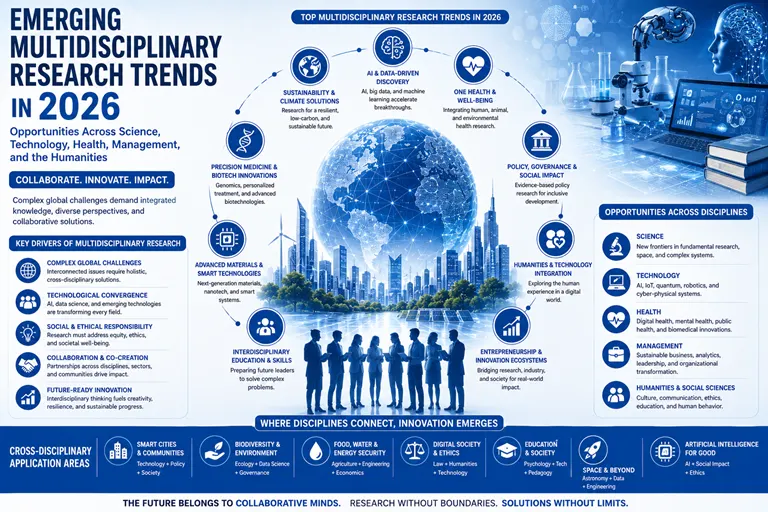
Emerging Multidisciplinary Research Trends in 2026: Opportunities Across Science, Technology, Health, Management, and the Humanities
Introduction: The Future of Research Is Multidisciplinary
The research landscape in 2026 is undergoing a significant transformation. Traditional disciplinary boundaries are rapidly dissolving, giving rise to a new era of multidisciplinary and interdisciplinary research.
Global challenges such as climate change, digital transformation, public health crises, and socio-economic inequality demand integrated solutions that combine knowledge from science, technology, health, management, and the humanities.
For journals like The Spectrum Journal, this shift presents a valuable opportunity to become a hub for cutting-edge research that bridges disciplines and drives innovation.
This article explores the most important multidisciplinary research trends in 2026 and highlights key opportunities for researchers, institutions, and policymakers.
Artificial Intelligence Across Disciplines
AI as a Universal Research Tool
Artificial Intelligence (AI) has become a foundational technology influencing almost every field of research.
AI is now widely used in:
- Healthcare diagnostics
- Financial modelling
- Climate prediction
- Social behaviour analysis
- Educational technology
Research Opportunities
- Explainable AI in healthcare and policy
- AI ethics and governance
- AI-driven decision-making systems
- Human-AI collaboration models
AI is no longer confined to computer science. It is a cross-disciplinary enabler.
Sustainable Development and Climate Research
Integrating Environment, Economy, and Society
Sustainability research continues to expand across disciplines, addressing:
- Climate change
- Resource management
- Renewable energy
- Urban sustainability
Research Opportunities
- Smart cities and sustainable infrastructure
- Climate-resilient agriculture
- Green finance and circular economy
- Environmental health studies
This area requires collaboration between environmental scientists, economists, engineers, and policymakers.
Digital Health and Integrated Healthcare Systems
Technology Meets Healthcare
The integration of digital technologies into healthcare is transforming medical research and practice.
Key areas include:
- Telemedicine
- Wearable health technologies
- AI-based diagnostics
- Health data analytics
Research Opportunities
- Personalised medicine
- Health system optimisation
- Digital health policy
- Preventive healthcare strategies
Multidisciplinary collaboration is essential for improving health outcomes.
Data Science and Big Data Integration
The Role of Data in Modern Research
Data-driven research is central to multidisciplinary studies.
Researchers now rely on:
- Big data analytics
- Machine learning
- Data visualisation tools
Research Opportunities
- Cross-sector data integration
- Predictive modelling
- Social data analysis
- Business intelligence systems
Data science connects disciplines by providing a common analytical framework.
Human-Centred Technology and Society
Understanding the Social Impact of Technology
As technology advances, understanding its societal impact becomes critical.
Research areas include:
- Digital ethics
- Privacy and data governance
- Social media influence
- Technology adoption behaviour
Research Opportunities
- Ethical AI frameworks
- Inclusive technology design
- Policy development for digital societies
This area bridges technology with social sciences and humanities.
Interdisciplinary Education and Learning Systems
Transforming Education Through Integration
Education research is evolving to incorporate:
- Digital learning platforms
- AI-based tutoring systems
- Cross-disciplinary curricula
Research Opportunities
- Educational technology innovation
- Skill development for future workforce
- Lifelong learning models
- Global education systems
This trend connects education, technology, psychology, and policy.
Economics, Business, and Sustainability Integration
Rethinking Economic Models
Economic research is increasingly aligned with sustainability and social impact.
Key areas include:
- ESG (Environmental, Social, Governance) frameworks
- Sustainable business practices
- Social entrepreneurship
Research Opportunities
- Circular economy models
- Impact investing
- Corporate sustainability strategies
This trend requires collaboration between economists, business leaders, and environmental experts.
Policy, Governance, and Global Collaboration
Evidence-Based Policy Making
Research is playing a critical role in shaping public policy.
Key focus areas include:
- Public health policy
- Environmental regulations
- Digital governance
Research Opportunities
- Policy impact evaluation
- Governance models for emerging technologies
- International cooperation frameworks
Multidisciplinary research ensures policies are informed by diverse perspectives.
Integrating Humanities with Science and Technology
The Human Perspective in Research
The humanities provide essential insights into:
- Culture
- Ethics
- History
- Communication
Research Opportunities
- Digital humanities
- Cultural analysis of technology
- Ethical frameworks in innovation
Integrating humanities ensures that technological progress remains human-centred.
Role of Multidisciplinary Journals in Shaping Research Trends
Providing a Platform for Innovation
Journals like The Spectrum Journal play a key role in:
- Publishing emerging research topics
- Encouraging cross-disciplinary collaboration
- Supporting innovative methodologies
Supporting Global Research Community
By promoting multidisciplinary research, journals contribute to:
- Knowledge integration
- Policy development
- Technological advancement
How Researchers Can Leverage These Trends
Identifying Research Opportunities
Researchers should:
- Stay updated with global trends
- Explore cross-disciplinary collaborations
- Focus on real-world impact
Building Collaborative Networks
Working with experts from different fields enhances:
- Research quality
- Innovation potential
- Publication success
Frequently Asked Questions (FAQs)
What are multidisciplinary research trends?
They are emerging areas of study that integrate multiple disciplines to address complex problems.
Why are these trends important?
They reflect the evolving nature of research and the need for integrated solutions.
How can researchers benefit from these trends?
By exploring new topics, collaborating across disciplines, and addressing global challenges.
What role do journals play?
Journals provide platforms for publishing and promoting emerging research.
Which fields are most involved?
Science, technology, health, management, social sciences, and humanities.
Conclusion: Embracing the Future of Research
The future of research lies in integration, collaboration, and innovation. Multidisciplinary research trends in 2026 highlight the importance of connecting diverse fields to address complex global challenges.
For journals like The Spectrum Journal, embracing these trends means:
- Supporting innovative research
- Encouraging interdisciplinary collaboration
- Contributing to global knowledge
Researchers, institutions, and policymakers must work together to leverage these opportunities and shape a more sustainable, inclusive, and technologically advanced future.