OJS vs ScholarJMS: Which Platform Is Better for a New Multidisciplinary Research Journal in 2026?
OJS vs ScholarJMS: Which Platform Is Better for a New Multidisciplinary Research Journal?
Introduction: The Platform Decision That Defines Your Journal’s Future
Launching a multidisciplinary research journal is a complex undertaking. Unlike discipline-specific journals, multidisciplinary platforms must manage submissions from diverse academic fields, coordinate reviewers across domains, and maintain consistent editorial quality across varied research formats.
At the centre of this entire ecosystem lies one critical decision:
Which journal management platform should you choose?
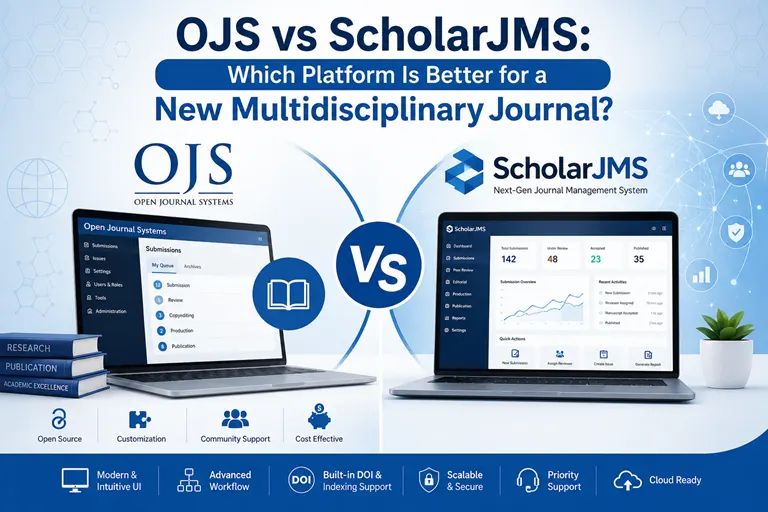
For most new journal founders, the comparison often comes down to:
- OJS (Open Journal Systems)
- ScholarJMS (Modern Journal Management System)
Both platforms can support scholarly publishing, but they differ significantly in terms of usability, scalability, workflow efficiency, and long-term growth potential.
This article provides a practical, experience-driven comparison to help editors, institutions, and publishers choose the right platform for launching and managing a multidisciplinary journal.
Understanding the Needs of a Multidisciplinary Journal
Why Platform Choice Is More Critical for Multidisciplinary Publishing
A multidisciplinary journal like The Spectrum Journal deals with:
- Multiple subject categories
- Diverse submission formats
- Varied reviewer expertise
- Different citation and formatting standards
- Interdisciplinary research methodologies
This means your platform must handle:
- Complex editorial workflows
- Efficient reviewer management
- Flexible article structures
- Strong metadata handling for indexing
- Smooth integration with ISSN and DOI systems
A basic or outdated system can quickly become a bottleneck.
What is OJS (Open Journal Systems)?
Overview of OJS
OJS is an open-source journal management platform developed by the Public Knowledge Project. It is widely used by universities and academic institutions around the world.
Key Features of OJS
- Manuscript submission and tracking
- Editorial workflow management
- Peer review support
- Basic publishing tools
- Plugin-based extensions
Strengths of OJS
- Free and open-source
- Large global user base
- Customisable through plugins
- Suitable for institutions with technical teams
Limitations of OJS for New Journals
Technical Complexity
OJS requires:
- Hosting setup
- Installation and configuration
- Regular updates and maintenance
- Technical troubleshooting
For new journals without dedicated IT teams, this can become a major challenge.
Outdated User Experience
Many editors and reviewers find OJS:
- Difficult to navigate
- Time-consuming for routine tasks
- Not intuitive for non-technical users
Workflow Inefficiencies
Managing:
- Reviewer assignments
- Editorial decisions
- Communication threads
can become cumbersome, especially for multidisciplinary journals handling high submission volumes.
Dependency on External Support
Most journals using OJS eventually rely on services like OJSCloud for:
- Hosting and maintenance
- Version upgrades
- Migration support
- Technical troubleshooting
- ISSN readiness and journal setup
What is ScholarJMS?
Overview of ScholarJMS
ScholarJMS is a modern, fully integrated journal management system designed to simplify the entire academic publishing workflow.
It is built specifically for:
- New journal launches
- Multidisciplinary journals
- Institutions without technical teams
- Publishers seeking automation and scalability
Key Features of ScholarJMS
- Complete journal website setup
- Integrated manuscript submission system
- Automated editorial workflow
- Reviewer management system
- Article publishing structure
- DOI-ready metadata handling
- Clean and intuitive interface
Advantages of ScholarJMS for Multidisciplinary Journals
All-in-One Publishing Ecosystem
ScholarJMS combines:
- Website
- Submission system
- Editorial workflow
- Publishing tools
into a single platform.
This eliminates the need for multiple tools or integrations.
User-Friendly Experience
Editors, reviewers, and authors benefit from:
- Simple dashboards
- Clear workflow steps
- Faster decision-making processes
Workflow Automation
ScholarJMS reduces manual effort by automating:
- Reviewer invitations
- Status tracking
- Email communication
- Editorial actions
This is particularly useful for multidisciplinary journals managing varied submissions.
Faster Journal Launch
Unlike OJS, which requires setup and configuration, ScholarJMS allows journals to:
- Go live quickly
- Start accepting submissions immediately
- Meet ISSN readiness requirements faster
OJS vs ScholarJMS: Detailed Comparison
Ease of Setup
- OJS: Requires hosting, installation, and technical setup
- ScholarJMS: Ready-to-use platform with minimal setup
Technical Requirement
- OJS: Needs IT support
- ScholarJMS: No technical expertise required
User Experience
- OJS: Functional but complex
- ScholarJMS: Modern and intuitive
Workflow Efficiency
- OJS: Manual and plugin-dependent
- ScholarJMS: Automated and streamlined
DOI Integration
- OJS: Requires plugin configuration
- ScholarJMS: Built with DOI-ready metadata structure
ISSN Readiness
- OJS: Depends on setup quality
- ScholarJMS: Structured to meet ISSN requirements
Maintenance
- OJS: Requires ongoing updates and support
- ScholarJMS: Managed platform
Choosing the Right Platform Based on Your Journal Goals
When OJS May Be Suitable
OJS can work well if:
- You have an institutional IT team
- You prefer open-source systems
- You are comfortable managing plugins and updates
- You already have OJS infrastructure
When ScholarJMS Is the Better Choice
ScholarJMS is ideal if:
- You are launching a new journal
- You want a faster go-to-market timeline
- You need a structured editorial workflow
- You want built-in DOI and metadata readiness
- You do not want technical complexity
Platform Choice and ISSN Approval
Why Your Platform Affects ISSN Approval
ISSN agencies evaluate:
- Website quality
- Editorial structure
- Publishing readiness
A well-structured platform like ScholarJMS increases your chances of approval by ensuring:
- Clear journal structure
- Professional presentation
- Transparent policies
OJS-based journals can also meet these requirements, but only with proper configuration and support, often through OJSCloud.
Platform Choice and Crossref DOI Integration
Why DOI Workflow Matters
DOI is not just about assigning identifiers. It requires:
- Structured metadata
- Consistent article formatting
- Integration with Crossref
How Platforms Handle DOI
- OJS: Requires manual setup and plugin configuration
- ScholarJMS: Designed with DOI-ready workflows
For journals seeking DOI support, GetDOI provides:
- Crossref sponsorship
- DOI setup
- Metadata validation
- Workflow guidance
Need Help Choosing or Setting Up Your Journal Platform?
Selecting the right platform is only the first step. Implementing it correctly is equally important.
We can help you with:
- ScholarJMS journal website setup
- OJS hosting, migration, and technical support via OJSCloud
- ISSN consulting and application guidance
- Crossref DOI setup through GetDOI
- Complete journal workflow design
- Multidisciplinary journal launch strategy
WhatsApp: +91 82003 85143
Direct link: https://wa.me/918200385143
Email: inquiry@ojscloud.com
Real-World Recommendation for New Multidisciplinary Journals
For most new and emerging journals, especially those without technical teams, the practical choice is:
- ScholarJMS for fast, structured, and scalable publishing
However, if you are already invested in OJS, then working with OJSCloud ensures your system remains stable, updated, and ISSN-ready.
The key is not just choosing a platform, but ensuring that your journal operates professionally from the beginning.
Frequently Asked Questions (FAQs)
Is OJS completely free to use?
Yes, OJS is open-source. However, hosting, maintenance, and technical support often involve costs.
Can I migrate from OJS to ScholarJMS later?
Yes. Migration is possible and can be managed with professional support.
Which platform is better for new journals?
ScholarJMS is generally better for new journals due to ease of use and faster setup.
Does platform choice affect indexing?
Indirectly, yes. A well-structured platform improves metadata quality and indexing readiness.
Do both platforms support DOI integration?
Yes, but ScholarJMS offers a more streamlined DOI-ready workflow.
Conclusion: Making the Right Choice for Long-Term Success
Choosing between OJS and ScholarJMS is not just a technical decision. It is a strategic choice that will influence your journal’s efficiency, credibility, and growth.
For multidisciplinary journals like The Spectrum Journal, the need for:
- Efficient workflows
- Clear editorial structure
- DOI-ready publishing
- ISSN readiness
makes platform selection even more critical.
If your goal is to launch quickly, manage submissions efficiently, and build a professional publishing ecosystem, then a modern system like ScholarJMS offers clear advantages.
If you are planning to start, upgrade, or migrate your journal, taking expert guidance early can save time, reduce complexity, and improve your chances of long-term success.
Get in touch today to discuss your journal setup, ISSN support, DOI integration, or platform migration.
WhatsApp: +91 82003 85143
Email: inquiry@ojscloud.com