
The Rise of Interdisciplinary Research: Why Complex Global Problems Require Collaboration Across Academic Fields
The Rise of Interdisciplinary Research: Why Complex Global Problems Require Collaboration Across Academic Fields
Introduction: A New Era of Research Thinking
The world today faces challenges that are increasingly complex, interconnected, and global in nature. Issues such as climate change, public health crises, technological disruption, economic inequality, and sustainable development cannot be effectively addressed by a single academic discipline.
This reality has led to the rapid rise of interdisciplinary research, where knowledge from multiple fields is integrated to develop comprehensive solutions.
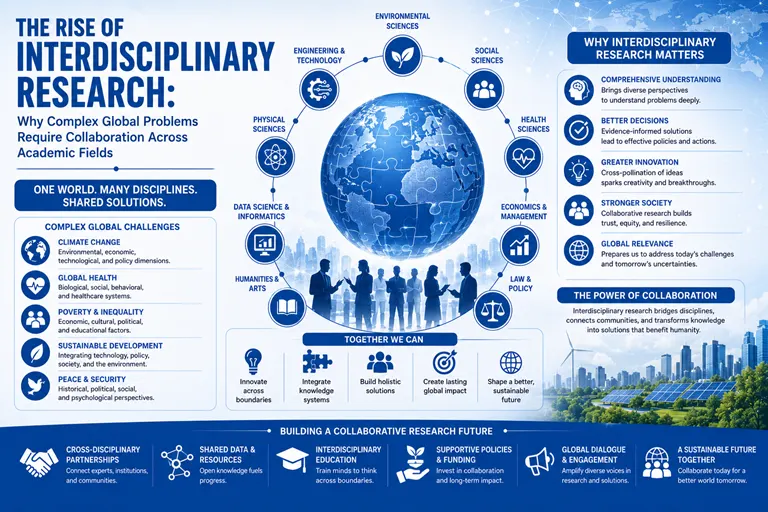
For journals like The Spectrum Journal, which embrace a broad academic scope, interdisciplinary research is not just relevant, it is essential. It reflects the evolving nature of knowledge creation and supports research that has real-world impact.
Understanding Interdisciplinary Research
What Is Interdisciplinary Research
Interdisciplinary research involves:
- Combining theories, methods, and perspectives from different disciplines
- Collaborating across academic boundaries
- Addressing problems that require integrated solutions
It differs from multidisciplinary research in that it emphasises integration and synthesis, rather than parallel contributions.
Why It Is Gaining Importance
The increasing complexity of global challenges requires:
- Diverse expertise
- Innovative thinking
- Collaborative problem-solving
Traditional discipline-based approaches are often insufficient.
The Nature of Complex Global Problems
Interconnected Challenges
Modern global issues are interconnected. For example:
- Climate change impacts health, agriculture, and economies
- Technological advancement influences employment, policy, and ethics
- Public health crises affect social systems and governance
Limitations of Single-Discipline Approaches
When problems are approached from a single perspective:
- Important factors may be overlooked
- Solutions may be incomplete
- Implementation may fail
Interdisciplinary approaches provide a more holistic understanding.
Key Drivers Behind the Rise of Interdisciplinary Research
Technological Advancements
Digital tools and data analytics enable:
- Cross-disciplinary data integration
- Collaborative research platforms
- Advanced modelling and simulation
Globalisation of Knowledge
Research is increasingly:
- International
- Collaborative
- Network-driven
Policy and Funding Support
Many funding agencies now prioritise:
- Interdisciplinary projects
- Collaborative research initiatives
- Applied research with societal impact
Benefits of Interdisciplinary Collaboration
Comprehensive Problem Solving
By integrating multiple perspectives, researchers can:
- Identify root causes
- Develop holistic solutions
- Address interconnected issues
Innovation and Creativity
Collaboration across disciplines often leads to:
- New ideas
- Novel methodologies
- Breakthrough discoveries
Increased Research Impact
Interdisciplinary research is more likely to:
- Influence policy
- Drive technological advancement
- Address societal needs
Challenges in Interdisciplinary Research
Communication Barriers
Different disciplines use:
- Unique terminologies
- Distinct conceptual frameworks
This can create misunderstandings.
Methodological Differences
Researchers may have:
- Conflicting research approaches
- Different evaluation standards
Coordination and Management
Managing interdisciplinary teams requires:
- Strong leadership
- Clear communication
- Defined roles
Overcoming Barriers to Collaboration
Establishing Common Ground
Teams should:
- Define shared objectives
- Develop a common language
- Align methodologies
Encouraging Open Communication
Regular interaction helps:
- Build trust
- Resolve conflicts
- Improve collaboration
Leveraging Technology
Digital tools can support:
- Data sharing
- Project management
- Collaborative analysis
Role of Academic Journals in Promoting Interdisciplinary Research
Providing a Platform for Integration
Journals like The Spectrum Journal play a key role by:
- Publishing cross-disciplinary research
- Encouraging collaboration
- Supporting innovative methodologies
Adapting Editorial and Peer-Review Systems
Interdisciplinary research requires:
- Diverse reviewer expertise
- Flexible evaluation criteria
- Balanced editorial decisions
A structured and modern peer-review system ensures fair and effective evaluation.
Interdisciplinary Research in Key Areas
Climate Change and Sustainability
Addressing climate change requires collaboration between:
- Environmental scientists
- Economists
- Policy experts
- Engineers
Healthcare and Public Health
Integrates:
- Medical research
- Social sciences
- Data analytics
- Policy frameworks
Technology and Society
Explores:
- Ethical implications of AI
- Digital transformation
- Socio-economic impacts
The Future of Interdisciplinary Research
Increasing Integration Across Fields
The boundaries between disciplines will continue to blur, leading to:
- Hybrid fields
- Collaborative networks
- Integrated research models
Role of Education and Training
Future researchers will need:
- Interdisciplinary skills
- Collaborative mindset
- Adaptability
Importance of Publishing Platforms
Journals must evolve to:
- Support diverse research formats
- Facilitate collaboration
- Ensure quality and transparency
Frequently Asked Questions (FAQs)
What is interdisciplinary research?
It is research that integrates knowledge and methods from multiple disciplines.
Why is it important?
Because complex global problems require comprehensive and integrated solutions.
What challenges does it face?
Communication barriers, methodological differences, and coordination issues.
How can researchers collaborate effectively?
By establishing clear goals, maintaining communication, and using collaborative tools.
What role do journals play?
They provide platforms for publishing and validating interdisciplinary work.
Conclusion: Advancing Knowledge Through Collaboration
The rise of interdisciplinary research reflects a fundamental shift in how knowledge is created and applied. As global challenges become more complex, collaboration across academic fields is no longer optional, it is essential.
For journals like The Spectrum Journal, supporting interdisciplinary research means:
- Encouraging innovation
- Bridging academic boundaries
- Contributing to real-world solutions
By fostering collaboration between disciplines, the academic community can develop more effective, sustainable, and impactful solutions to the challenges facing our world today.