
Sustainable Development Research Across Disciplines: Connecting Technology, Health, Economics, Policy, and Society
Sustainable Development Research Across Disciplines: Connecting Technology, Health, Economics, Policy, and Society
Introduction: Why Sustainability Requires Multidisciplinary Thinking
Sustainable development is no longer confined to environmental science alone. It has evolved into a complex global priority that intersects with technology, health systems, economic structures, governance, and societal behaviour.
The United Nations Sustainable Development Goals (SDGs) highlight this interconnectedness by addressing issues such as poverty, health, education, climate change, economic growth, and institutional strength.
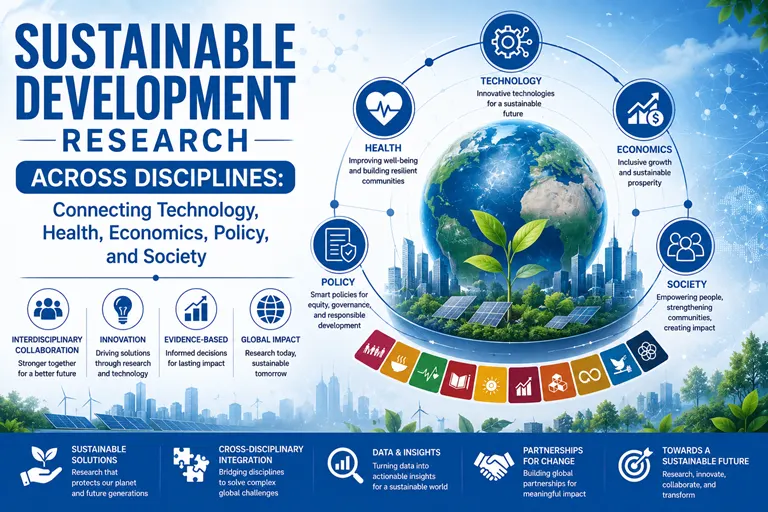
For journals like The Spectrum Journal, which promote multidisciplinary research, sustainability offers a powerful thematic foundation. It encourages collaboration across fields and supports research that delivers real-world solutions.
Understanding sustainable development today means recognising that no single discipline can address global challenges independently.
The Multidisciplinary Nature of Sustainable Development
Beyond Environmental Science
Sustainable development encompasses:
- Environmental protection
- Public health and well-being
- Economic stability and growth
- Social equity and inclusion
- Governance and public policy
Each of these domains is deeply interconnected.
For example:
- Climate change affects health outcomes
- Economic inequality influences environmental degradation
- Policy decisions shape technological adoption
The Role of Multidisciplinary Journals
Multidisciplinary journals play a critical role by:
- Providing a platform for cross-disciplinary dialogue
- Encouraging integrated research methodologies
- Supporting innovative solutions
- Bridging academic and policy perspectives
This aligns closely with the vision of modern research publishing.
Technology and Sustainable Development
Digital Innovation as a Catalyst
Technology is a key driver of sustainability. Innovations in:
- Artificial intelligence
- Internet of Things (IoT)
- Data analytics
- Renewable energy systems
- Smart infrastructure
are transforming how societies address sustainability challenges.
Examples of Technology-Driven Sustainability
- Smart grids improving energy efficiency
- AI-based climate modelling
- Precision agriculture reducing resource waste
- Digital health platforms expanding access to care
These advancements demonstrate how engineering and computer science contribute directly to sustainability goals.
Health and Sustainability: An Integrated Perspective
Environmental Health Linkages
Health outcomes are closely tied to environmental conditions. Issues such as:
- Air and water pollution
- Climate change
- Urbanisation
- Resource scarcity
directly affect public health.
Multidisciplinary Health Research
Sustainable health research integrates:
- Medical sciences
- Environmental science
- Public health policy
- Social determinants of health
This approach supports:
- Preventive healthcare strategies
- Climate-resilient health systems
- Community-based interventions
Economics and Sustainable Development
Balancing Growth and Sustainability
Economic systems play a central role in sustainability. The challenge lies in:
- Promoting growth
- Ensuring resource efficiency
- Reducing inequality
- Supporting long-term environmental goals
Key Economic Concepts
- Circular economy
- Green finance
- Sustainable supply chains
- Inclusive growth models
These concepts require collaboration between economists, policymakers, and environmental scientists.
Policy and Governance in Sustainability
Role of Public Policy
Effective sustainability initiatives depend on:
- Regulatory frameworks
- Government policies
- Institutional capacity
- International cooperation
Policy-Oriented Research
Multidisciplinary research informs policy by:
- Providing evidence-based insights
- Evaluating program effectiveness
- Identifying implementation challenges
Strong collaboration between researchers and policymakers is essential.
Social Dimensions of Sustainable Development
Importance of Community and Culture
Sustainability is not just a technical or economic issue. It is deeply social.
Factors such as:
- Cultural practices
- Education levels
- Community engagement
- Behavioural change
influence the success of sustainability initiatives.
Social Science Contributions
Disciplines such as sociology, psychology, and education help:
- Understand human behaviour
- Design effective interventions
- Promote awareness and adoption
Interdisciplinary Research Methodologies
Integrating Multiple Perspectives
Multidisciplinary sustainability research requires:
- Mixed-method approaches
- Collaborative research teams
- Cross-sector partnerships
Challenges in Interdisciplinary Research
Researchers often face:
- Differences in terminology
- Methodological conflicts
- Data integration issues
Despite these challenges, interdisciplinary approaches yield more comprehensive insights.
Role of Academic Journals in Advancing Sustainability Research
Publishing Cross-Disciplinary Work
Journals like The Spectrum Journal provide:
- A platform for integrated research
- Visibility for emerging sustainability topics
- Opportunities for collaboration
Supporting Research Impact
By publishing multidisciplinary sustainability research, journals contribute to:
- Policy development
- Technological innovation
- Social transformation
Future Trends in Sustainable Development Research
Emerging Areas of Focus
- Climate adaptation technologies
- Sustainable urban development
- Digital sustainability solutions
- Health resilience systems
- ESG (Environmental, Social, Governance) frameworks
Importance of Collaboration
Future progress depends on:
- Academic partnerships
- Industry collaboration
- Policy integration
- Global research networks
Frequently Asked Questions (FAQs)
What is multidisciplinary sustainable development research?
It is research that integrates multiple disciplines to address sustainability challenges.
Why is sustainability a multidisciplinary issue?
Because it involves environmental, economic, social, technological, and policy factors.
How can researchers contribute to sustainability?
By conducting interdisciplinary studies and proposing practical solutions.
What role do journals play in sustainability research?
They provide platforms for sharing knowledge and promoting collaboration.
Are multidisciplinary journals important for sustainability?
Yes, they enable integration of diverse perspectives and innovative solutions.
Conclusion: Building a Sustainable Future Through Integrated Research
Sustainable development is one of the most pressing challenges of our time. Addressing it requires collaboration across disciplines, sectors, and regions.
Multidisciplinary journals like The Spectrum Journal are uniquely positioned to support this effort by:
- Encouraging cross-disciplinary research
- Publishing innovative solutions
- Connecting academia, policy, and society
As research continues to evolve, the integration of technology, health, economics, policy, and social sciences will remain essential for achieving sustainable development goals.
Researchers, institutions, and policymakers must work together to build a future that is not only innovative but also sustainable, inclusive, and resilient.