
How to Write a High-Quality Multidisciplinary Research Paper for Journal Publication
How to Write a High-Quality Multidisciplinary Research Paper for Journal Publication
Introduction: Writing for a Multidisciplinary Audience
Writing a research paper is a demanding task. Writing a multidisciplinary research paper is even more challenging. It requires not only strong academic writing but also the ability to integrate perspectives from different fields into a coherent and meaningful narrative.
For journals like The Spectrum Journal, which publish across diverse disciplines such as engineering, health sciences, social sciences, management, and environmental studies, authors must ensure that their research is both rigorous and accessible.
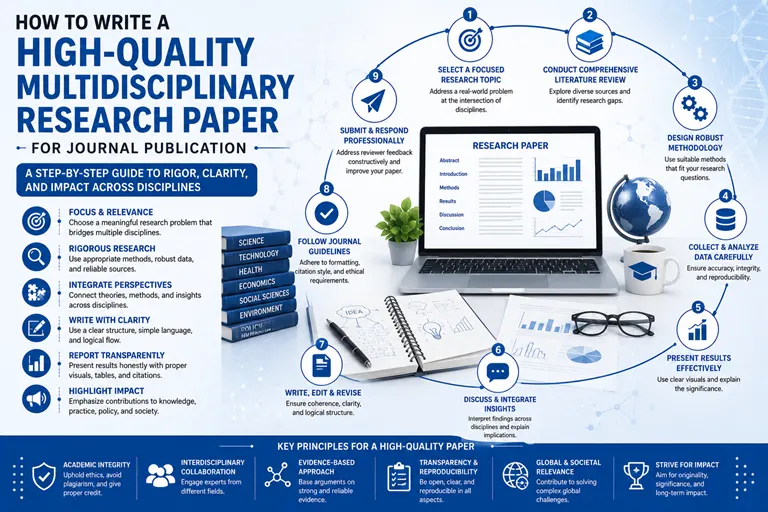
A high-quality multidisciplinary paper does more than present findings. It connects ideas, bridges knowledge gaps, and contributes to solving complex real-world problems.
This guide provides a practical, step-by-step approach to writing a publishable multidisciplinary research manuscript.
Understanding Multidisciplinary Research Writing
What Makes Multidisciplinary Papers Different
Unlike single-discipline papers, multidisciplinary research:
- Integrates theories and methods from multiple fields
- Addresses complex, real-world problems
- Requires broader contextual explanation
- Must be understandable to a wider academic audience
This means authors must balance depth and clarity.
Common Challenges Authors Face
- Combining different methodologies
- Managing diverse terminology
- Structuring arguments coherently
- Meeting expectations of reviewers from multiple disciplines
Recognising these challenges early helps improve the quality of your manuscript.
Choosing a Strong Research Topic
Aligning with Multidisciplinary Scope
Your topic should:
- Address a problem that spans multiple disciplines
- Offer innovative or integrative insights
- Be relevant to current global or societal issues
For example:
- AI in healthcare systems
- Sustainable urban development
- Climate change and public health
- Digital transformation in education
Ensuring Novelty and Relevance
Before finalising your topic:
- Conduct a literature review
- Identify research gaps
- Define your contribution clearly
Structuring a Multidisciplinary Research Paper
Standard Manuscript Structure
Most journals, including The Spectrum Journal, expect the following structure:
- Title
- Abstract
- Keywords
- Introduction
- Literature review
- Methodology
- Results
- Discussion
- Conclusion
- References
Writing for Cross-Disciplinary Clarity
Ensure that:
- Concepts are explained clearly
- Discipline-specific jargon is minimised
- Arguments are logically connected
Your goal is to make the paper accessible to readers from different fields.
Writing an Effective Abstract and Title
Crafting a Clear Title
Your title should:
- Reflect the multidisciplinary nature
- Include key variables or themes
- Be concise and informative
Writing a Strong Abstract
A good abstract should include:
- Research objective
- Methods used
- Key findings
- Main conclusion
Keep it clear and structured.
Conducting a Comprehensive Literature Review
Integrating Multiple Disciplines
Your literature review should:
- Cover relevant studies from all involved fields
- Highlight connections between disciplines
- Identify gaps that your study addresses
Avoiding Fragmentation
Do not present literature in isolated sections. Instead:
- Synthesize insights
- Build a unified narrative
Designing a Robust Methodology
Combining Methods Effectively
Multidisciplinary research often uses:
- Quantitative analysis
- Qualitative methods
- Experimental designs
- Computational models
Ensure your methodology:
- Is clearly explained
- Justifies the use of each method
- Demonstrates integration
Addressing Validity and Reliability
Explain how you:
- Ensure data accuracy
- Maintain consistency
- Validate findings
Presenting Results Clearly
Organising Results
Present findings in a structured manner:
- Use tables and figures where appropriate
- Group results logically
- Avoid unnecessary complexity
Linking Results to Objectives
Ensure that each result directly relates to your research questions.
Writing a Strong Discussion Section
Interpreting Multidisciplinary Findings
The discussion should:
- Explain the significance of results
- Connect findings across disciplines
- Compare with existing literature
Highlighting Practical Implications
Explain how your research:
- Solves real-world problems
- Contributes to policy, technology, or society
Ensuring Ethical Compliance
Ethical Considerations in Writing
Ensure:
- Proper citation of sources
- Avoidance of plagiarism
- Transparency in data reporting
Ethical Approvals
If applicable, include:
- Institutional approvals
- Consent statements
- Ethical declarations
Following Journal Reporting Standards
Adhering to Guidelines
Check the journal’s author guidelines for:
- Formatting requirements
- Referencing style
- Word limits
Using Reporting Frameworks
Depending on your study, follow:
- PRISMA
- CONSORT
- STROBE
These improve clarity and credibility.
Preparing for Journal Submission
Final Checklist Before Submission
- Manuscript is complete and formatted
- References are accurate
- Figures and tables are labelled
- Ethical statements are included
Submission Process
Modern systems like ScholarJMS make submission easier by:
- Guiding authors step-by-step
- Ensuring required fields are completed
- Tracking manuscript status
Improving Acceptance Chances
Common Reasons for Rejection
- Weak methodology
- Poor structure
- Lack of novelty
- Inadequate literature review
Tips for Success
- Follow journal scope strictly
- Write clearly and concisely
- Address reviewer expectations
- Revise thoroughly before submission
Frequently Asked Questions (FAQs)
What is a multidisciplinary research paper?
It is a paper that integrates knowledge from multiple disciplines to address complex problems.
How long should a research paper be?
Length depends on journal guidelines, but typically ranges between 3000 to 8000 words.
Can I use multiple methodologies?
Yes, but they must be well-integrated and justified.
How do I choose a journal?
Select a journal that matches your research scope and audience.
What improves acceptance chances?
Strong methodology, clarity, relevance, and adherence to guidelines.
Conclusion: Writing for Impact and Publication Success
Writing a high-quality multidisciplinary research paper requires:
- Clear objectives
- Integrated methodology
- Ethical integrity
- Structured reporting
For journals like The Spectrum Journal, well-written multidisciplinary papers contribute to advancing knowledge across fields and addressing global challenges.
By focusing on clarity, rigor, and relevance, authors can significantly improve their chances of publication and make meaningful contributions to the academic community.